Commercial Locksmith Arlington: Master Key Systems, Access Control & Panic Hardware (2026 Guide)
Quick answer: A commercial locksmith project in Arlington usually has three parts. A master key system to ANSI/BHMA A156.5 lets you control who opens which doors with a tiered key hierarchy — figure a few hundred dollars for a small office up to several thousand for a multi-zone building, more with restricted keyways. Access control replaces or supplements keys with credentials (card, fob, or phone) and runs from a few hundred dollars per door for cloud systems into the thousands per door for wired enterprise hardware. Panic and exit hardware is governed by International Building Code Section 1010 and NFPA 101 and is non-negotiable on required egress doors. Spec for how you will grow, not just today's door count.
Master key systems: controlling who opens what
A master key system gives you a tiered hierarchy of access from a single, planned keying scheme. A change key opens one door; a master key opens a defined group; a grand master opens everything. For an Arlington office, retail space, or multi-tenant building, that means a property manager can hold one key that opens all common areas while each tenant's key opens only their suite. The system is designed once, on paper, before a single cylinder is cut.
The standard to specify is ANSI/BHMA A156.5, which grades the cylinders and input devices used in commercial master systems. Within that, the biggest cost-and-security decision is the keyway. A standard keyway is cheaper but lets anyone duplicate keys at a hardware store. A restricted or patented keyway — Schlage Everest, Medeco, or Mul-T-Lock MT5+, many of them UL 437 listed — controls duplication so keys can only be cut by an authorized dealer with documentation. For any building where lost-key control matters, restricted is worth the premium.
Pricing scales with door count, grade, and keyway. A small office of a handful of doors on a standard keyway can land in the low hundreds; a multi-zone building on a restricted, UL-listed keyway with a deep hierarchy runs into the thousands. The number that actually drives long-term cost is not today's door count — it is whether the keyway and hierarchy were designed with room to expand.
Access control: cloud vs panel
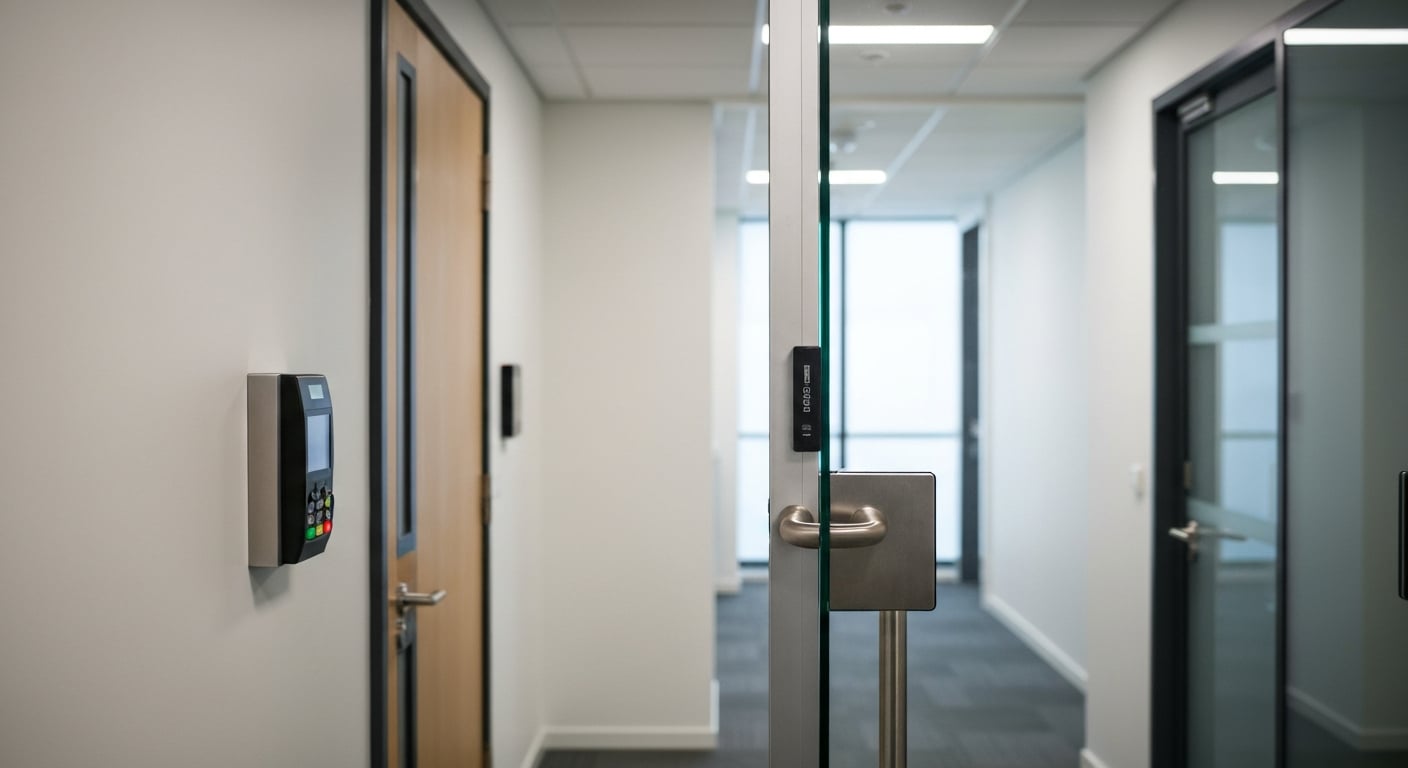
Access control replaces or supplements mechanical keys with credentials — a card, a fob, a PIN, or increasingly a phone. The advantage over keys is administrative: you can grant access to a new hire in seconds, revoke a terminated employee instantly, set schedules so a door unlocks during business hours, and pull an audit log of every entry. For an Arlington business with turnover or multiple shifts, that control is the whole point.
The architecture splits into cloud and panel-based. Cloud platforms — Brivo, Kisi, Openpath, Schlage Engage — manage doors from a web dashboard, scale easily, and suit single-door to mid-size deployments with the lowest up-front hardware cost, often a few hundred dollars per door plus a subscription. Panel-based or wired enterprise systems put more intelligence on-site, integrate with larger building systems, and cost more per door but suit large facilities with strict uptime and compliance needs.
Whichever path, the National Institute of Standards and Technology IoT cybersecurity guidance applies: an access-control system is networked infrastructure. Specify hardware that receives firmware updates, segment it on the network, and manage credentials and admin accounts with the same discipline you would any business system. A door controller with default passwords on the open internet is a liability, not a security upgrade.
- Cloud (Brivo, Kisi, Openpath, Schlage Engage): lowest up-front cost, easiest to scale, subscription-based
- Panel / wired enterprise: higher per-door cost, on-site intelligence, best for large or compliance-heavy facilities
- Credentials: card, fob, PIN, or mobile — mobile reduces lost-credential churn
- Always specify: firmware updates, network segmentation, audit logging, instant revocation
Panic and exit hardware: this part is the law
Panic hardware (the push-bar that opens a door with a single motion) and fire-exit hardware are not optional aesthetics — they are life-safety requirements enforced by code. International Building Code Section 1010 defines where panic hardware is required, generally on egress doors serving assembly and certain high-occupancy or hazardous spaces, and how those doors must operate. NFPA 101, the Life Safety Code, sets parallel egress requirements that Arlington fire marshals enforce during inspection.
The fire-rating distinction is critical. A door in a fire-rated wall needs fire-exit hardware that is UL 10C listed for use on a labeled fire-door assembly, and the hardware must not include a mechanism (like a dogging feature that holds the latch retracted) that would defeat the fire rating. Installing standard panic hardware where fire-exit hardware is required is a common failure an inspector will flag — and a genuine safety gap. Von Duprin, Sargent, Yale, and Detex all make code-compliant devices in both fire-rated and non-fire-rated versions.
The practical rule for any Arlington business: before you change anything on an egress door, confirm whether it is part of a rated assembly and what the local code official requires. Retrofitting the wrong device is more expensive than speccing the right one, because failed inspection means doing the job twice plus re-inspection.
Speccing a system that scales past 50 doors
Small systems forgive bad planning; large ones do not. Once a building approaches or passes 50 doors, the decisions that matter are structural. On the mechanical side, the master key hierarchy needs enough keyway headroom that adding a floor or a leased suite does not force a full re-cut — the mistake the operator quote above describes. Plan the hierarchy on paper for the building you expect in three to five years, not the one you occupy today.
On the electronic side, scale favors systems with central management, role-based administration, and clean integration between access control and other building systems. A 50-plus-door deployment usually blends both worlds: high-traffic and remote doors on access control for instant revocation and audit logs, lower-risk interior doors on a well-planned master key system to control hardware and subscription cost. Mixing the two deliberately, rather than putting every door on the most expensive option, is how larger Arlington facilities keep the budget sane.
Texas regulates the companies doing this work under Occupations Code Chapter 1702 through the Texas DPS Private Security Program, so confirm any commercial provider holds a current company license. For a multi-zone building, the provider should be able to deliver a written keying schedule, a door-by-door hardware schedule, and a plan that maps your egress doors to IBC 1010 and NFPA 101 requirements before any hardware is ordered.
Commercial access methods compared
| Method | Up-front cost | Best for | Key standard |
|---|---|---|---|
| Master key (standard keyway) | Lowest | Simple offices, low lost-key risk | ANSI/BHMA A156.5 |
| Master key (restricted keyway) | Low-medium | Control of key duplication | A156.5 + UL 437 |
| Cloud access control | Medium (per door + subscription) | Turnover, multi-shift, audit needs | Vendor + NIST IoT guidance |
| Wired enterprise access | Highest (per door) | Large / compliance-heavy facilities | Vendor + NIST IoT guidance |
| Panic / fire-exit hardware | Required where code applies | All required egress doors | IBC 1010 / NFPA 101 / UL 10C |
"The most expensive commercial mistake is speccing for the building you have instead of the building you will have. I have re-cut master systems eighteen months after install because the company leased the suite next door and the original keyway had no room to expand. Plan the hierarchy and pick a keyway with headroom on day one — it costs almost nothing extra up front and saves a full re-key later."
— Licensed commercial locksmith, 15 years master-key and access-control work, Tarrant County (anonymized)
Sourced stats
- International Building Code Section 1010 sets the operational requirements for egress doors, including where panic and fire-exit hardware is required and how it must function. — International Code Council (2021)
- NFPA 101, the Life Safety Code, governs egress and panic-hardware requirements that fire marshals enforce during commercial inspections. — National Fire Protection Association (2024)
- ANSI/BHMA A156.5 is the standard for cylinders and input devices used in master key systems, defining the grading commercial buyers should specify. — Builders Hardware Manufacturers Association (2024)
- Fire-rated exit hardware must carry UL 10C / UL 437 listings for use on labeled fire-door assemblies, a detail inspectors check on commercial egress doors. — UL Solutions (2024)
Related services
Frequently asked questions
How much does a commercial master key system cost in Arlington?
It scales with door count, grade, and keyway. A small office on a standard keyway can land in the low hundreds, while a multi-zone building on a restricted, UL-listed keyway with a deep hierarchy runs into the thousands. Specify ANSI/BHMA A156.5 and plan keyway headroom so growth does not force a full re-cut later.
Should I choose cloud or wired access control?
Cloud platforms (Brivo, Kisi, Openpath, Schlage Engage) have the lowest up-front cost, scale easily, and suit single-door to mid-size deployments. Wired enterprise systems cost more per door but suit large, compliance-heavy facilities. Many Arlington buildings mix both — high-traffic doors on access control, lower-risk interior doors on a master key system.
Is panic hardware legally required on my business doors?
On required egress doors, often yes. International Building Code Section 1010 and NFPA 101 define where panic and fire-exit hardware is required, typically on assembly and high-occupancy spaces. Doors in fire-rated walls need UL 10C-listed fire-exit hardware. Confirm requirements with the local code official before changing any egress door.
What is a restricted keyway and do I need one?
A restricted or patented keyway (Schlage Everest, Medeco, Mul-T-Lock MT5+) controls key duplication so keys can only be cut by an authorized dealer with documentation, unlike a standard keyway anyone can copy at a hardware store. If lost-key control matters for your building, the restricted keyway premium is usually worth it.
How do I verify a commercial locksmith in Texas?
Texas regulates locksmith companies under Occupations Code Chapter 1702 through the DPS Private Security Program. Confirm the provider holds a current company license. For a larger project, they should also deliver a written keying schedule, a door-by-door hardware schedule, and an egress plan mapped to IBC 1010 and NFPA 101 before ordering hardware.
Sources cited
- Builders Hardware Manufacturers Association — ANSI/BHMA A156 product certification standards (2024)
- International Code Council — International Building Code Section 1010 — Doors, Gates, and Turnstiles (2021)
- National Fire Protection Association — NFPA 101 Life Safety Code — egress and panic hardware requirements (2024)
- UL Solutions — UL 437 (key locks) and UL 10C (fire door assemblies) certification standards (2024)
- Texas Department of Public Safety — Private Security Program — Private Security regulation (Occupations Code Ch. 1702) — company and individual licensing (2024)
- National Institute of Standards and Technology — NISTIR 8259 / IoT device cybersecurity capability guidance (2022)
- U.S. Census Bureau — QuickFacts: Arlington city, Texas (population, housing, owner-occupancy) (2024)